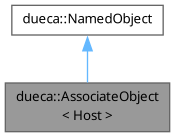
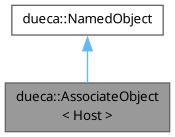
Proxy identity for helper classes associated with an object derived from dueca::NamedObject. More...
#include <AssociateObject.hxx>
Public Member Functions | |
| AssociateObject (const Host &host) | |
| Constructor. | |
| ~AssociateObject () | |
| Destructor. | |
| ObjectType | getObjectType () const final |
| Object type for DUECA's sanity. | |
| Public Member Functions inherited from dueca::NamedObject | |
| const std::string | getEntity () const |
| Returns the "entity" part of the name. | |
| const std::string | getClass () const |
| Returns the "class" part of the name. | |
| const std::string | getPart () const |
| Returns the sub-entity or "part" part of the name. | |
| const NameSet & | getNameSet () const |
| This returns the complete name set. | |
| const GlobalId & | getId () const |
| This returns the id. | |
Static Public Attributes | |
| static const char *const | classname |
| Class name constant, should be equal to the host object's classname, used for reporting errors and warnings. | |
Additional Inherited Members | |
| Protected Member Functions inherited from dueca::NamedObject | |
| NamedObject (const GlobalId &id) | |
| Reserve for AssociateObject. | |
| NamedObject (const NameSet &ns) | |
| Normal constructor, protected, because it has no use to create a NamedObject by itself. | |
| virtual | ~NamedObject () |
| Destructor. | |
Detailed Description
class dueca::AssociateObject< Host >
Proxy identity for helper classes associated with an object derived from dueca::NamedObject.
In DUECA, objects that can use DUECA services (accessing channels, creating and using activities) need to have a name and a GlobalId, commonly by deriving from NamedObject. In addition, the convenience macros for checking channels and the like normally use the dueca::getclassname<>() templated function to access the "classname" member defined in modules.
This template class enables helper classes/objects that don't have their own GlobalId to assume the GlobalId and name of their "owner", and sets the proper class name.
Use this to delegate capabilities in a manner like (note, incomplete code!):
In your c++ file, ensure that the helpers have the proper "classname":
The MyHelper struct will now be able to open channels, create activities, etc. Its name and id are equal to that of the host class.
Constructor & Destructor Documentation
◆ AssociateObject()
|
inline |
Constructor.
- Parameters
-
host Host class for name and ID.
Member Function Documentation
◆ getObjectType()
|
inlinefinalvirtual |
Object type for DUECA's sanity.
Implements dueca::NamedObject.
The documentation for this class was generated from the following files:
- /home/abuild/rpmbuild/BUILD/dueca-4.3.2-build/dueca-4.3.2/dueca/NamedObject.hxx
- /home/abuild/rpmbuild/BUILD/dueca-4.3.2-build/dueca-4.3.2/dueca/AssociateObject.hxx